PerformanceSpan

Don't just add years to your life. Protect the performance within them.

After 50, the objective should not simply be living longer. It should be keeping the physical and mental capacity to carry on doing the things that matter — working, travelling, training, lifting, walking, playing, and living without asking permission from your body.

We call that your PerformanceSpan: the number of years you remain capable of operating at or close to your personal physical and mental best. It is what every part of myHealthCoach is designed to extend.

Free, 20 questions, about five minutes — scored across strength, cardiovascular fitness, nutrition and recovery, with no details required.

The definition

Lifespan, healthspan, PerformanceSpan

Most conversations about ageing stop at length of life, or at the absence of illness. Neither tells you what you are still able to do. PerformanceSpan is our framework for thinking about that third question — and it is a philosophy of coaching, not an established clinical metric.

01

Lifespan

How long you live. Useful, but on its own it tells you nothing about the quality of those years or what you were still able to do in them.

02

Healthspan

How long you remain broadly free from significant disease or disability. A better measure — but you can be classed as healthy and still have lost a great deal of physical capacity.

03

PerformanceSpan

How long you retain a high level of strength, fitness, energy, mobility, resilience and capability relative to your own potential. This is what we coach towards.

Healthy is not the same as capable

Someone can be free of diagnosed disease and still have lost a considerable amount of strength, aerobic fitness and mobility. They pass every check and still avoid the stairs, the floor, the heavy suitcase and the long walk. So the more useful question is not simply “Am I ill?” but “What am I still capable of doing?”

Why it matters after 50

The strategy changes. The opportunity doesn't.

In your twenties, training is often about appearance or short-term performance. From midlife onwards, strength, cardiovascular fitness, nutrition and recovery become investments in future capability. That shift is not pessimistic — decline is not inevitable, uniform or fixed, and many people are fitter and stronger at 60 than they were at 40. Age changes the strategy; it does not remove the opportunity to improve.

What we are actually protecting

  • Getting off the floor easily, without planning the route back up
  • Carrying your own luggage through an airport without a second thought
  • Climbing several flights of stairs without becoming excessively breathless
  • Maintaining muscle and strength rather than quietly losing them each decade
  • Continuing to run, cycle, hike, ski, swim or play the sport you enjoy
  • Travelling confidently, including long days and awkward schedules
  • Remaining independent and self-sufficient for as long as possible
  • Keeping up with children and grandchildren rather than watching from a chair
  • Handling demanding working periods without your health being the casualty
  • Recovering effectively from hard days, poor sleep and heavy weeks
  • Retaining confidence in what your body can be asked to do

The four foundations

Strength, fitness, nutrition and recovery

PerformanceSpan is built on four physical foundations. None of them is complicated. All four are difficult to sustain across a demanding working life — which is exactly why behaviour and accountability sit alongside them.

01

Strength

Strength is your physical reserve.

Muscle and strength underpin almost everything you want to keep doing: lifting, carrying, climbing, balancing, catching yourself, staying steady on your feet. Strength built now is capability held later, and it is the foundation most often neglected by people who consider themselves reasonably active.

What we work on

  • Maintaining muscle rather than accepting a slow decline
  • Functional strength that transfers to real tasks, not just gym numbers
  • Physical confidence in what you can lift, carry and manage
  • Balance and stability, which depend on strength as much as on practice
  • The ability to perform everyday tasks without thinking about them
  • Keeping the training capacity to progress for years to come

02

Cardiovascular Fitness

Fitness determines how much life you can comfortably participate in.

Your cardiovascular system is the engine behind work, exercise and ordinary life. When aerobic fitness improves, everything from a demanding week to a long walk with the family costs you less. VO₂ max is one useful measure of aerobic capacity, but the more honest test is how you feel doing the things you actually want to do.

What we work on

  • An aerobic base built through steady, sustainable work
  • Stamina for long days rather than short efforts
  • The ability to recover between efforts, sessions and weeks
  • Zone 2 style easy work as the bulk of the volume
  • Appropriately scaled higher-intensity work where it suits you
  • Walking, running, cycling, swimming, rowing — whichever modality you will keep doing
03

Nutrition

Eat to support the body you want to keep using.

Nutrition here is about supporting performance, recovery and maintained muscle — not dieting. Rigid plans tend to survive quiet weeks and collapse on difficult ones. Priorities also change with age and activity, so what worked for you at 30 may not be what serves you best now.

What we work on

  • Sufficient protein to support and maintain muscle
  • Mostly minimally processed food, prepared in ways you will repeat
  • Plenty of fruit and vegetables across the week
  • Energy intake matched to your training and your goals
  • Hydration treated as part of performance, not an afterthought
  • Eating around training so sessions are fuelled and recovered from
  • A healthy body composition where that is a relevant goal for you
04

Recovery

You don't become stronger from training alone. You become stronger by recovering from it.

Training provides the stimulus; recovery is where adaptation happens. This is the foundation busy professionals most often get wrong — not because they do too little, but because they try to add training to an already saturated week and then wonder why progress stalls and niggles accumulate.

What we work on

  • Sleep protected as one of the highest-leverage recovery habits
  • Stress managed deliberately rather than absorbed indefinitely
  • Genuine rest days, planned rather than forced on you
  • Sensible spacing between demanding sessions
  • Total workload — work, travel, family and training — considered together
  • Avoiding the trap of constantly doing more when results slow
  • Scaling training down through the most demanding periods, then back up

Capacity over appearance

The scales tell you what you weigh. They don't tell you what you're capable of.

Weight loss can be a perfectly legitimate goal, and we coach it where it matters to you. But after 50 it is a poor sole measure of progress. Someone can lose weight and lose muscle, strength and energy at the same time — and be measurably less capable at a lower bodyweight.

Better questions to ask yourself

  • Are you stronger than you were six months ago?
  • Is your cardiovascular fitness improving?
  • Can you move well, and get in and out of positions comfortably?
  • Are you sleeping better?
  • Do you have more energy through the working day?
  • Can you handle physical challenges without hesitating?
  • Are you maintaining muscle rather than losing it?
  • On balance, are you becoming more capable?
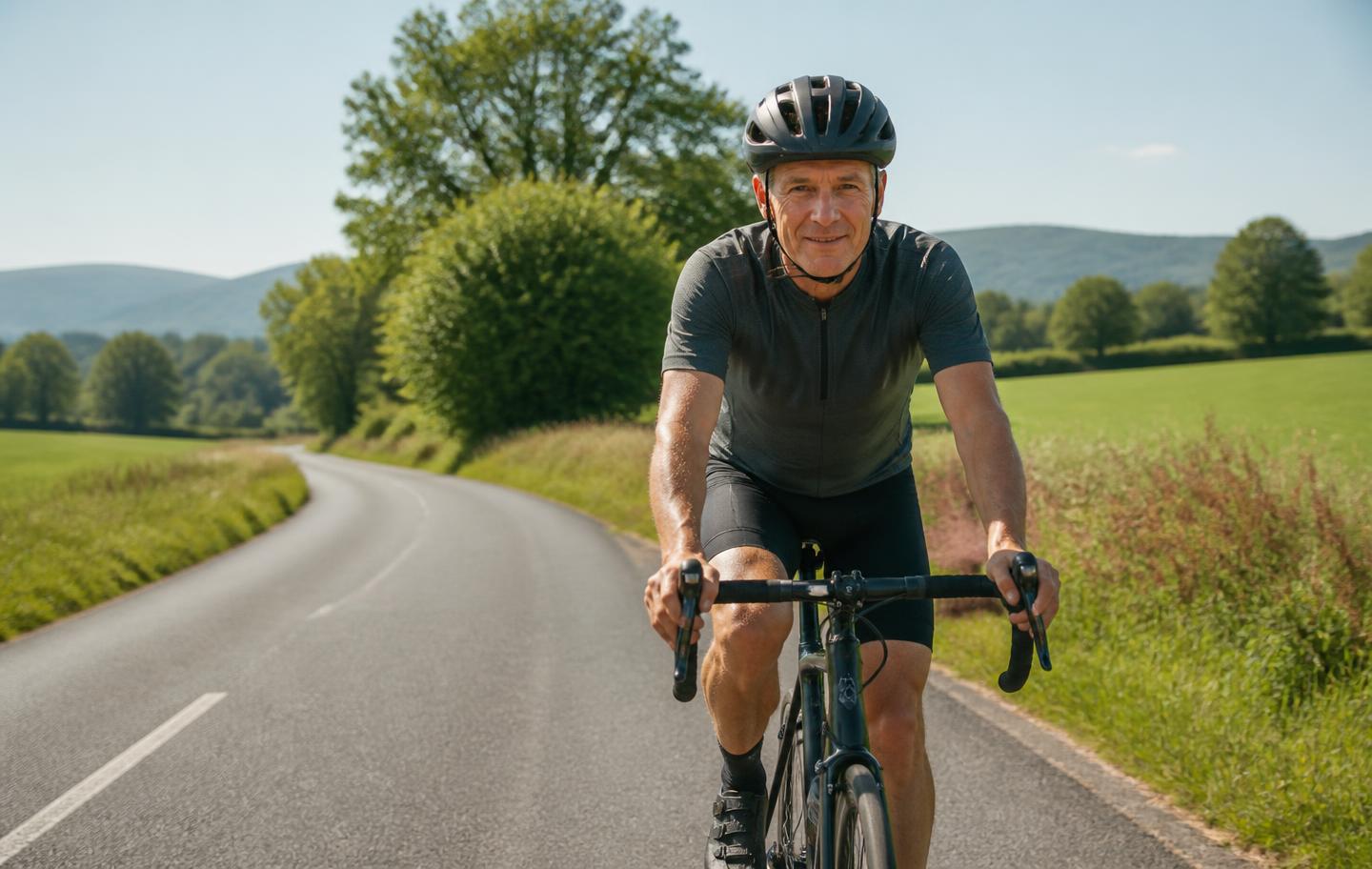
A woman in her fifties lifting weights in a bright gymA man in his early sixties cycling on a quiet country roadA man in his fifties resting and recovering at home after training

Measurement

How to measure your PerformanceSpan

What gets measured can be managed — but the aim is a handful of honest signals, not obsessive tracking. The right measures depend entirely on you, your goals and your starting point. PerformanceSpan is about your personal trajectory; comparing a 55-year-old with a professional athlete tells you nothing useful.

Strength progression

What you can lift, carry and control over time — the clearest signal that reserve is being built rather than spent.

Cardiovascular fitness

Aerobic capacity and how a given effort feels. Resting heart rate can be a useful, low-effort trend to watch.

Performance in your activity

Walking, running, cycling, swimming or sport: pace, distance and how comfortably you complete it.

Mobility and movement quality

Whether you can reach, rotate, squat and get up and down without working around restrictions.

Body composition where useful

Weight, body composition or a waist measurement, used as one input among several rather than the verdict.

Sleep, energy and recovery

How well you sleep, how you feel at 4pm, and how quickly you bounce back from a hard session or week.

Consistency

Sessions completed, habits held, weeks not lost. Over decades this predicts more than any single number.

Meaningful physical tasks

The practical things you want to keep doing. If those are getting easier, the trend is right.

The direction of travel matters more than any single reading. Two or three measures you will actually keep reviewing beat a dashboard you abandon.

About the PerformanceSpan Assessment

The PerformanceSpan Assessment is a free 20-question self-assessment across the four pillars — Strength, Cardiovascular Fitness, Nutrition and Recovery. It usually takes around 4–6 minutes, and your results appear immediately with no contact details required.

What it measures

Your current behaviours and the practical capability foundations that support staying strong, fit, energetic, resilient and independent as you age.

What it does not measure

It is not a medical examination, a disease-risk predictor, a VO2max or frailty test, a body-composition scan, or a validated clinical instrument.

What you receive immediately

  • An overall PerformanceSpan score out of 100.
  • A score for each of the four pillars, with score bands.
  • Your strongest pillar and your priority pillar.
  • A short personalised recommendation for every pillar.

Why it is useful

  • Turns a vague goal like “age well” into four areas you can act on.
  • Shows what is already working, so you keep it.
  • Reveals the pillar currently limiting you.
  • Helps you prioritise instead of improving everything at once.
  • Creates a baseline you can repeat later, and makes a coaching conversation more focused.

Want a starting point today?

Answer for your typical behaviour over the last four to six weeks and you will get an honest, useful snapshot. It is an educational coaching self-assessment, not a medical or clinical test.

W.I.S.D.O.M. and PerformanceSpan

PerformanceSpan is the destination. W.I.S.D.O.M. is how you keep travelling towards it.

This page describes what we are trying to preserve. It does not, on its own, make anyone do it. That is the gap almost every capable, well-informed professional falls into — and it is behavioural, not educational.

You know strength training protects capability

Knowing it does not put three sessions in the diary during a quarter-end week, or keep them there for the next ten years.

You understand that sleep matters

Understanding it does not stop work repeatedly consuming your evenings, or change what you do at 11pm.

You know what nutritious food looks like

Knowledge does not automatically decide what happens when you are stressed, travelling, eating out or exhausted.

Why we combine all three

  • Physical strategy defines what to do: strength, fitness, nutrition, recovery.
  • Behaviour change through W.I.S.D.O.M. decides whether you keep doing it when life gets difficult.
  • Accountability turns intention into action, week after week.

PerformanceSpan defines what we are building. W.I.S.D.O.M. makes the behaviours sustainable. The assessment shows which of the six pillars is most likely to stop you.

In coaching

How the philosophy becomes your plan

Coaching starts where you are now, not where a programme assumes you should be. We build a picture first, then a strategy you can hold on to.

First we assess

  • Your goals, and what capability you want to protect
  • Current fitness and strength
  • Exercise history, including what has and has not worked
  • Your real schedule, travel and working demands
  • Nutrition as it actually is, not as it should be
  • Sleep, stress and recovery
  • Lifestyle, constraints and preferences
  • Existing habits and routines
  • Your W.I.S.D.O.M. profile from the assessment

Then we build the strategy

Nutrition
Built around your week, preferences and training rather than a template.
Exercise
Strength and cardiovascular work scaled to your time, history and goals.
Lifestyle
Routines, defaults and environment that make the plan survivable.
Recovery
Sleep, rest and workload planned in, not left to chance.
Behaviour
W.I.S.D.O.M. applied to the habits that carry the plan.
Accountability
Daily contact and review so drift is caught in days.

Think in decades

Don't train for the next six weeks. Train for the next twenty years.

Short-term goals are genuinely useful. Losing weight, running a 10K, adding strength, preparing for an event, getting fitter before a holiday — they focus attention and create momentum, and we use them.

The trap

The problem is when the six-week goal is the whole strategy. A hard push, a result, a stop — then months of drift before the next push. Repeated across a decade, that pattern leaves you no more capable than when you started, only more tired of starting.

The alternative

Put the short-term goals inside a bigger one: remaining strong, fit and capable for decades. Then a difficult month is a detail rather than a failure, and the question stops being “can I stick to this for six weeks?” and becomes “can I still be doing a version of this at 70?”

Every session, meal and night of sleep is a small deposit into the person you will be in twenty years. You are not training for the next six weeks. You are training for the two or three decades in which you would still like to be fully involved in your own life.

Where it came from

Chris Deavin, founder of myHealthCoach

I have spent more than 25 years coaching exercise, nutrition and behaviour change. PerformanceSpan reflects how that philosophy has evolved as my clients — and I — have aged. The focus becomes steadily less about looking fit and increasingly about retaining the ability to live fully: to work hard, train, travel, keep up and stay independent for as much of later life as possible.

Questions

Frequently asked

What is PerformanceSpan?

PerformanceSpan is the number of years you remain capable of operating at or close to your personal physical and mental best. It is the myHealthCoach way of thinking about ageing — not simply how long you live, but how long you stay strong, fit, mobile, energetic and capable of doing what matters to you.

Is PerformanceSpan the same as healthspan?

No. Healthspan usually describes the years lived broadly free from significant disease or disability. PerformanceSpan is a higher bar: how much strength, fitness, energy, mobility and resilience you retain relative to your own potential. PerformanceSpan is our framework and philosophy, not an established clinical measurement.

Can I improve my fitness after 50?

Very often, yes. Age changes the strategy — recovery, progression and workload need more thought — but it does not remove the opportunity to get stronger and fitter. Many people arriving in their fifties and sixties have simply never trained in a structured, consistent way before.

Do I need to train extremely hard?

No. Consistency across years beats intensity across weeks. Well-scaled resistance training, an aerobic base you can maintain, sensible nutrition and genuine recovery will do far more for your capability than short bursts of very hard work followed by long gaps.

Is weight loss still important?

It can be a perfectly legitimate goal, and for many people it improves how they move and feel. We simply do not treat it as the only measure of success. Strength, fitness, mobility, sleep, energy and maintained muscle all matter alongside it.

How do I measure my PerformanceSpan?

Through the measures that reflect your own trajectory: strength progression, cardiovascular fitness, resting heart rate, walking or running performance, mobility, body composition or waist measurement where useful, sleep quality, energy, recovery and consistency. The right set depends on you and your goals.

How does W.I.S.D.O.M. relate to PerformanceSpan?

PerformanceSpan is the destination — what we are trying to preserve and extend. W.I.S.D.O.M. is the behavioural system that makes the daily actions sustainable. Knowing that strength training protects capability is not the same as training consistently for twenty years.

Do I need medical clearance before starting exercise?

Nothing on this page is medical advice. If you have a medical condition, take medication, are experiencing symptoms, or have any concern about your health, please speak with your doctor or an appropriate healthcare professional before significantly changing your exercise or nutrition.

Next step

Your future capability is being built by what you repeatedly do today.

Not by what you intend to do in January. The best place to start is to find out which behaviour is most likely to stop you — that takes about ten minutes.