About Chris Deavin

In 25 years of coaching, I've learned that knowing what to do is rarely the main problem.

I'm Chris Deavin, founder of myHealthCoach. I coach busy professionals, business owners and leaders — mostly over 50 — who are capable, informed and successful in almost every other area of their lives, and yet cannot seem to make their health stick.

The gap is almost never knowledge. It is implementation: doing the right things consistently, through demanding weeks, travel, pressure and everything else that real life puts in the way.

Where it started

Good plans, very different outcomes

My coaching career began in the 1990s, working with people primarily through exercise, nutrition and personal training. The work was hands-on: assess someone, design a sensible programme, guide them through it and adjust as they progressed.

What kept happening

Two people could receive an equally good plan and end up in completely different places. One followed it through busy periods, setbacks and disruption. The other started well, then stalled — not through ignorance, and not through lack of desire.

What that told me

The difference was not the programme. It was everything around it: willingness, identity, simplicity, the design of the week, the ability to recover from a bad spell, and the mindset applied to all of it. That observation has shaped my coaching ever since.

How the coaching evolved

From writing programmes to changing behaviour

Over time my work moved away from simply prescribing workouts and nutrition, and towards the behaviour that determines whether any of it happens. This is the implementation gap that everything at myHealthCoach is built to close.

01

From prescription to behaviour

Better programmes and better nutrition advice only help someone who can act on them consistently. So the work moved from writing plans to building the behaviour that carries them.

02

From willpower to structure

Motivation arrives and leaves. Structure — routines, defaults, protected commitments — is what keeps a plan alive on a difficult week.

03

From effort to environment

Most decisions are shaped by the surroundings they are made in. Designing the week and the environment removes the need to win every decision on the day.

04

From perfection to resilience

Everyone has poor days. What separates people is how quickly they return. Recovering from setbacks is a coachable skill, not a character trait.

05

From isolated advice to accountability

Daily contact and honest review turn intentions into a record of action, and catch drift within days rather than months.

06

From short-term change to identity

Results last when someone becomes the sort of person who looks after their health, rather than someone temporarily trying to.

Why over 50

Age changes the strategy, not the opportunity

My work has increasingly focused on professionals and leaders in midlife, because this is where the implementation gap is widest and the stakes are highest. Careers are demanding, responsibilities have accumulated, and health is usually the first thing to be postponed — just as strength, fitness, energy, recovery and mobility start to require deliberate attention.

What is really going on at this stage of life

  • Careers are at their most demanding, with responsibility that does not pause
  • Family, business and financial obligations have accumulated over decades
  • Health quietly slides to the bottom of a very long priority list
  • Strength and muscle need deliberate protection rather than assumption
  • Cardiovascular fitness becomes central to energy and stamina at work
  • Sleep, stress and recovery have a far larger effect than they once did
  • Mobility determines what stays comfortable and what becomes avoided
  • Future capability — being able, active and independent later — becomes the real goal

None of this is a decline story. Plenty of people are stronger and fitter at 60 than they were at 40. What changes after 50 is the approach: more emphasis on strength, recovery and consistency, and far less on punishing plans that were never sustainable anyway.

My own perspective

This is my stage of life too

I'm over 50 myself, so this is not theoretical work for me. I care about strength, fitness, resilience and staying capable for the long term, and I plan my own week around the same realities my clients face: workload, tiredness, travel and the temptation to postpone the things that matter.

That is the point of mentioning it — relevance, not self-promotion. I coach the approach I use, and I would rather be honest about how ordinary the difficulties are than pretend consistency is effortless for anyone.

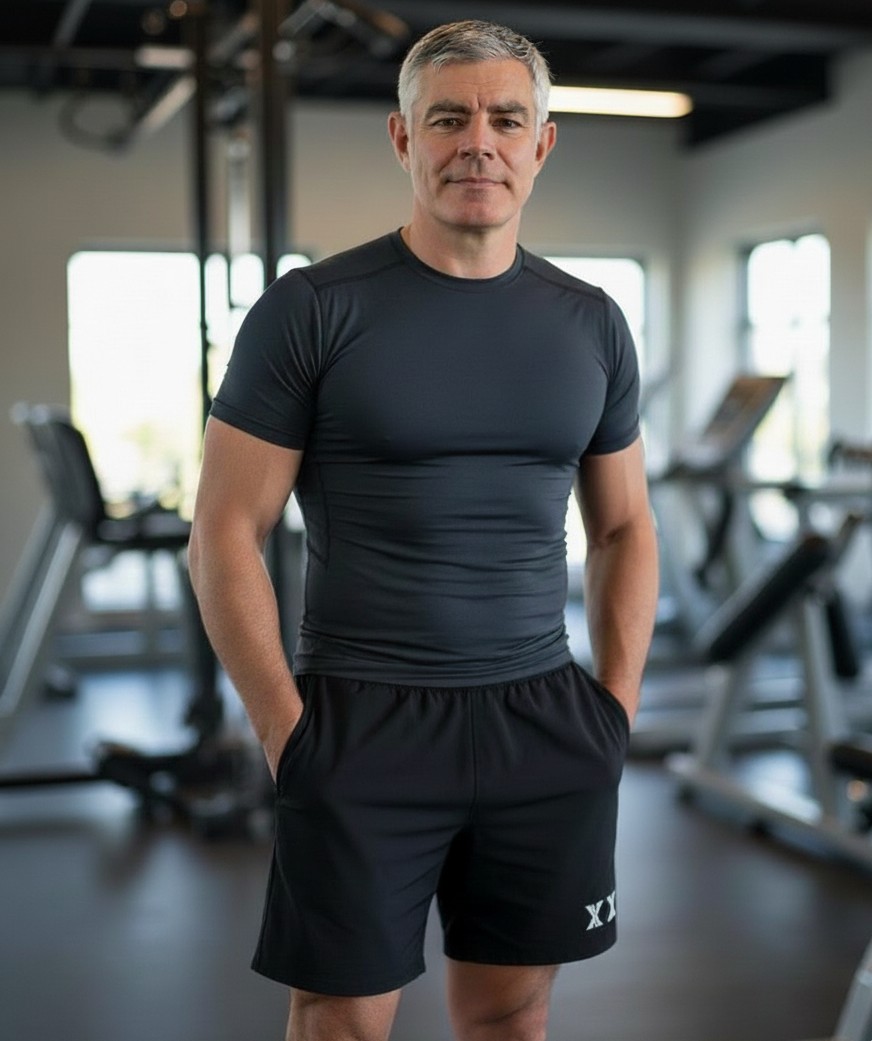
Chris Deavin in training kit in the gym
Chris in the gym — the same habits he coaches, on ordinary weeks.

The two ideas behind myHealthCoach

A framework, and a philosophy

Everything I coach sits on two ideas. One explains how change actually happens. The other explains what we are changing for.

W.I.S.D.O.M.

The behaviour-change framework

Six pillars that determine whether a plan is carried out. Strengthen the weak ones and consistency stops depending on how you feel that morning.

  • WWillingness What you are genuinely willing to do, and to trade.
  • IIdentity Becoming the person for whom the result is normal.
  • SSimplicity Simple enough to repeat on your hardest week.
  • DDesign A week and environment that make action easy.
  • OOvercome A reliable response to setbacks and disruption.
  • MMindset Thinking that supports action, not excuses.

PerformanceSpan

The long-term philosophy

The years you stay strong, fit, energetic, mobile and capable. Not just how long you live, but how much of your life you can fully take part in.

  • Strength — the physical reserve behind everything you want to keep doing
  • Cardiovascular fitness — energy and stamina for demanding days
  • Nutrition — eating to support the body you intend to keep using
  • Recovery — sleep, rest and workload, where adaptation actually happens
  • Capability — the real measure: what you are still able to do

What working with me is like

Structured, personal and honest

Coaching is a working relationship, not a document. You get a strategy built for your life, contact that keeps it moving, and a review process that keeps it accurate.

Personalised strategy

A plan built around your history, health, schedule, preferences and goals — not a template handed to everyone.

Practical planning around real life

Training, nutrition and recovery arranged around travel, workload and family, so the plan survives contact with your diary.

Simplicity first

We start with the smallest set of actions that genuinely move the needle, and add complexity only once consistency exists.

Honest feedback

Straight conversation about what is working, what is not, and what is being avoided. Encouraging where it helps, direct where it matters.

Daily accountability

Regular contact so commitments are visible and small slips are addressed while they are still small.

Review and adaptation

Structured review of progress, then adjustment. The plan is expected to change as your life and results change.

Long-term support

The aim is capability you keep, not a short burst of change followed by a return to where you started.

Coaching philosophy

The principles I coach by

These are the guiding principles behind every plan, conversation and review. They are the reason the coaching looks the way it does.

  • Structure over motivation
  • Consistency over perfection
  • Capability over appearance
  • Behaviour before optimisation
  • Personalisation over generic programmes
  • Long-term performance over short-term transformation
  • Action before inspiration

Fit

Who I work best with

This is likely a good fit

  • Professionals, business owners and leaders, primarily 50 and over
  • People who broadly know what to do but are not doing it consistently
  • Anyone tired of the stop-start cycle of restarting every few months
  • Those who want structure, accountability and honest feedback
  • People willing to change behaviour, not just receive information
  • Anyone who wants to stay strong, fit and capable for decades, not weeks

This is probably not for you

  • Anyone looking for a quick fix or a rapid transformation
  • People who want extreme diets or punishing training plans
  • Anyone hoping for a passive solution that requires nothing of them
  • People unwilling to participate in planning, review and accountability

Experience

More than 25 years of coaching behaviour, not just programmes

I have spent over 25 years coaching exercise, nutrition and behaviour change. That experience is why myHealthCoach focuses on implementation, accountability and sustainable health for people whose lives are already full — rather than on plans that only work in quiet weeks.

Next step

Start with the W.I.S.D.O.M. Assessment

It is free, takes a few minutes, and shows you which behavioural pillars are strong and which are quietly costing you results. It is the best possible starting point — and the fastest way for us to have a useful conversation.